About the Center
Administrative Body
CMRET is administered by the Marine Minerals Administration (MMA) of the U.S. Department of the Interior.
Primary Objective
To investigate and assess mineral resources within the U.S. Economic Exclusive Zone (EEZ) including rigorous study of the seafloor ecological conditions.
Education
CMRET provides leadership and facilities for education and training of the nation's scientist and engineers in the field of ocean mineral development.
History
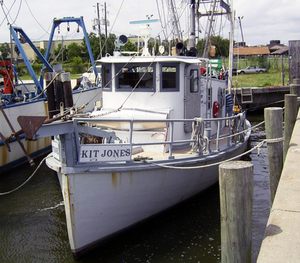
In 1988, the U.S. Congress authorized the establishment of marine mineral research centers as part of the national Minerals Institutes Program. Under Dr. Bob Woolsey’s leadership, the University of Mississippi was selected as the host institution for the new Marine Mineral Technology Center (MMTC), with Dr. Woolsey appointed as its first director. Woolsey acquired the vessel Kit Jones which became the only University of Mississippi Research Vessel. In 1996, the program was reauthorized by Congress under the Marine Mineral Resources Research Act, and MMTC was renamed the Center for Marine Resources and Environmental Technology (CMRET), becoming the marine research branch of MMRI. Oversight of CMRET was transferred in 1998 to the Minerals Management Service (now MMA), due to the agency’s jurisdiction over mineral leasing on the Outer Continental Shelf (OCS).
In October 1999, through Dr. Woolsey’s initiative, the Gulf of Mexico Gas Hydrates Research Consortium was formed, bringing together leading experts from 17 academic institutions and industry. Jointly supported by NOAA, MMS, and DOE, the consortium identified a gas hydrate mound in Mississippi Canyon Block 118 (Northern Gulf of Mexico) as the site for the first permanent seafloor observatory in the region. Between 1999 and his untimely death in 2008, Dr. Woolsey led MMRI–CMRET through a decade of groundbreaking research in marine minerals, gas hydrates, seafloor exploration, underwater robotics, and sensor development. His legacy endures not only in the Institute’s achievements but also in the many young scientists he mentored—including one who would eventually succeed him as director.
Following his passing, from 2008 to 2010, Mrs. Carol Blanton Lutken served as interim director of MMRI. Under her leadership, MMRI secured additional funding from the Department of Energy’s National Energy Technology Laboratory (NETL) to investigate fracture-filled gas hydrates using resistivity methods. She also played a pivotal role in obtaining a Rapid Response Grant from the National Science Foundation to monitor Mississippi River outflow during the historic 2010 Gulf of Mexico flood.
For a number of years CMRET was in hiatus due to shifts in funding and science interests. MMRI director Leo Macelloni renewed interest in CMRET in 2025 by establishing a cooperative agreement with the Department of Interior - Marine Minerals Administration (MMA) to investigate the potential of deep sea brine pools to host significant critical mineral accumulation.