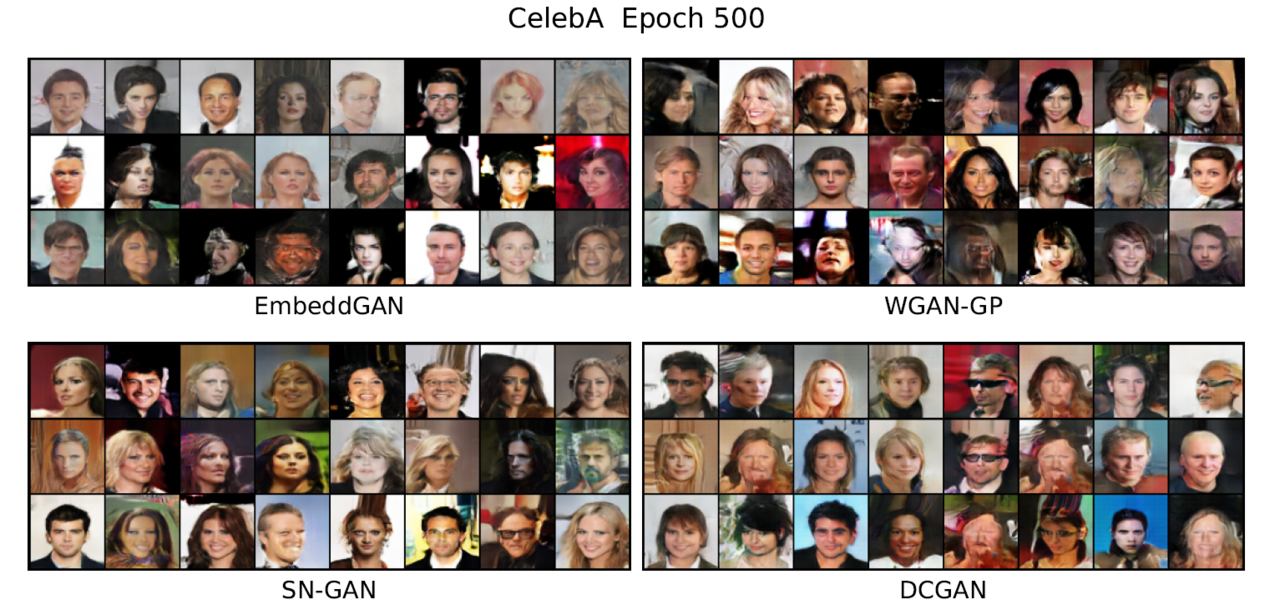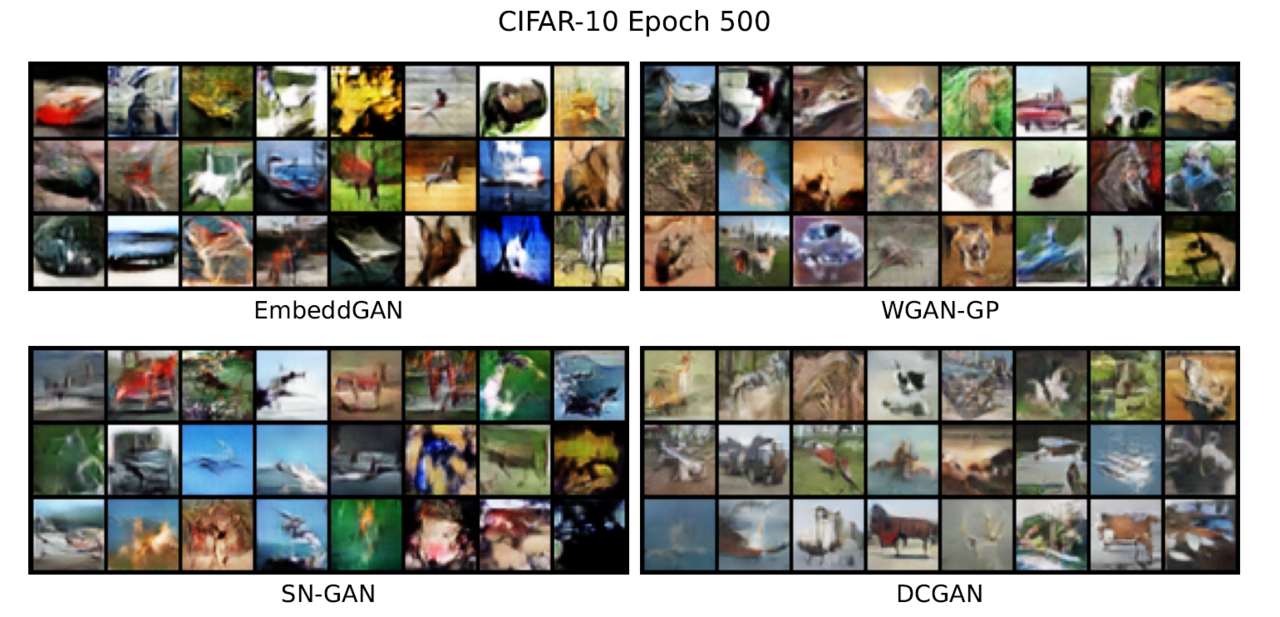
Generative Adversarial Networks (GANs) are a widely used class of AI models for creating realistic synthetic images, but they can be difficult to train, since the standard setup pits two networks against each other in a way that often leads to instability or repetitive, low diversity outputs. EmbeddGAN takes a different approach: instead of using a traditional "discriminator" that simply labels images as real or fake, it uses an embedding network that learns compact representations of the data and measures how statistically similar generated images are to real ones using a principled correlation based technique. This reframes the adversarial process around aligning entire data distributions rather than winning a classification game, giving the model a clearer, more interpretable training signal and making it easy to directly visualize how well the generated data matches the real data during training.
Our team has tested EmbeddGAN on multiple image datasets, including handwritten digits, everyday objects, and human faces, showing it can produce competitive image quality against well established GAN variants. We've also extended the approach with a conditional version, cEmbeddGAN, which generates images from specific categories on command (for example, a particular clothing item or digit rather than a random one), and are exploring new architectural directions beyond the original design. Ongoing work focuses on precisely characterizing the specific failure modes that can still emerge over long training runs, using tools like frequency domain analysis and embedding space visualization, with the broader goal of building generative models that are both well understood and suited to privacy preserving applications.